
Member Spotlight: ECBF VC
The bioeconomy has undergone a major shift in recent years. We are witnessing a transition from what was once a niche, circular-economy initiative primarily focused on waste reduction and sustainability to a central driver of industrial policy and global consumption, projected to account for a third of global economic value by 2050.
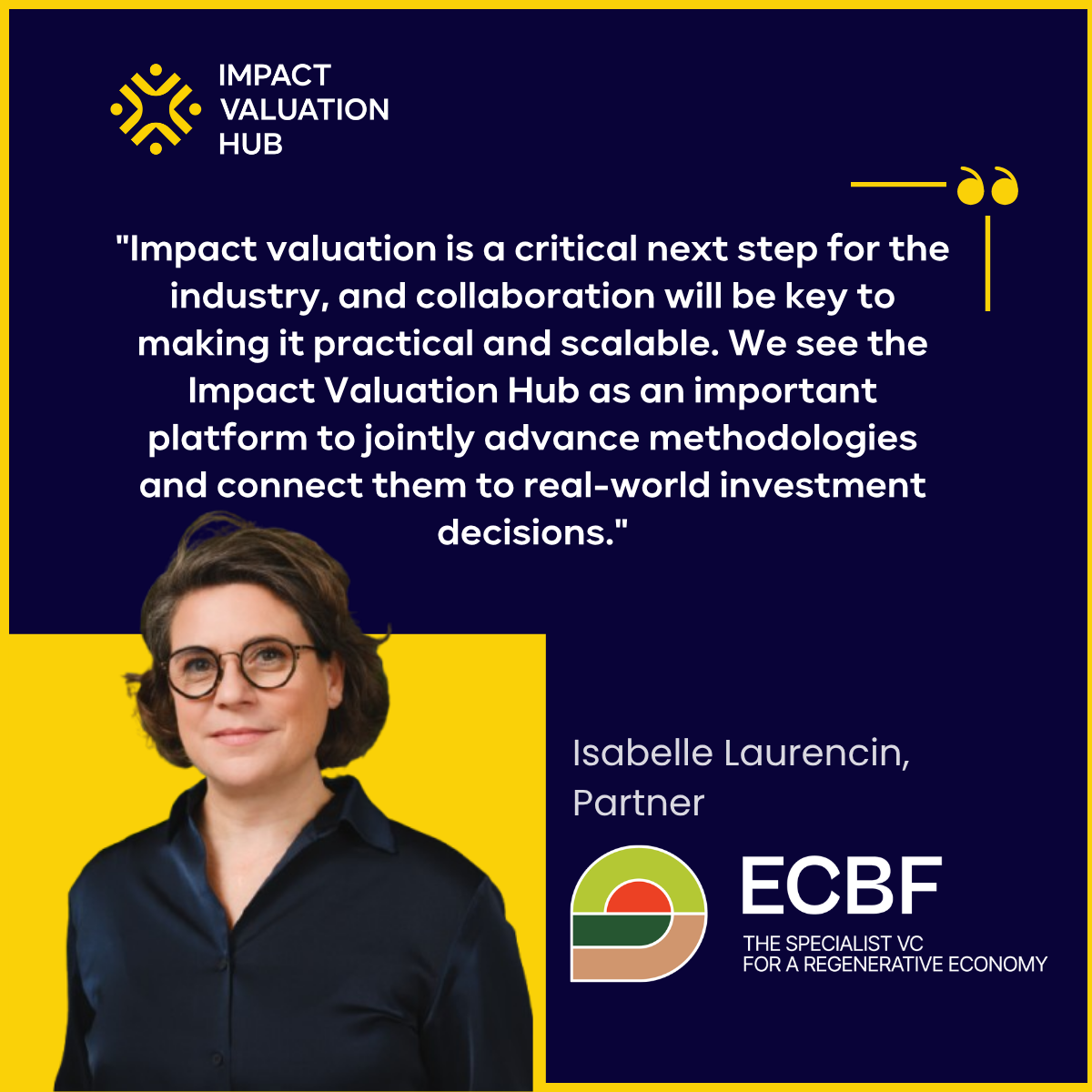
One of the newest members of the IV Hub, ECBF VC was always ahead of the curve. A pioneering investor in the sector, they have joined the IV Hub as the bioeconomy industry reaches an inflection point which reflects a broader reality: a more integrated view of regenerative and circular systems across all major industries. From food and agriculture, to materials, industrial processes and resource recovery, ECBF is investing in a future where nature and economy are aligned.
We spoke with Isabelle Laurencin, Partner at ECBF VC, and Cornelia Mann, Head of Communications, about what joining the IV Hub means to them, the importance of impact valuation for their fund, and what their new identity signals.
What does your fund invest in, and what impact areas are you focused on?
ECBF VC invests in growth-stage companies driving the transition to a regenerative, circular economy. We focus on science- and technology-based businesses across bioeconomy and circularity, from sustainable food and nutrition to industrial biotech and advanced materials.
Our strategy follows a “two systems, one strategy” approach, targeting both biological and industrial systems. In terms of impact, we are evolving towards a multi-dimensional framework covering climate change mitigation, circular resources use, nature, including biodiversity, and human and animal health, reflecting the systemic nature of today’s challenges.
What prompted you to join the IV Hub, and what were you hoping to get out of it?
We joined the IV Hub to engage with a leading community shaping impact valuation methodology.
Our goal is to exchange best practices, contribute to emerging standards, and methodologies on impact valuation , while enhancing the transparency and validating the credibility of our own approach.
Why do you see impact valuation as important for your investment practice?
Impact valuation is key to moving beyond measurement toward decision-making. In the bioeconomy, innovations often create multiple, interconnected benefits that are not fully reflected in market prices.
Impact valuation helps make these effects more visible and comparable, enabling better capital allocation and aligning impact more closely with long-term value creation.
You recently rebranded. How will this new positioning, combined with your partnership with the Impact Valuation Hub, help you to drive your long-term vision?
Our long-term vision is to help advance an economy where growth, resilience, and environmental regeneration reinforce each other. The new brand positioning helps articulate that vision more clearly by strengthening ECBF’s identity as a specialist platform focused on scaling technologies and business models that enable systemic transformation.
The collaboration with the Impact Valuation Hub is an important complement to this direction. As the market matures, there is growing demand for more sophisticated ways to understand, quantify, and communicate impact alongside financial performance. This partnership supports our ambition to contribute to a more evidence-based and transparent impact ecosystem.
It also strengthens one of ECBF’s core beliefs: that measurable impact and long-term value creation are deeply connected. By combining sector expertise, structured impact integration, and stronger valuation methodologies, we can better support portfolio companies, strengthen credibility with stakeholders, and help drive more informed capital allocation toward regenerative and circular solutions.
Where do you see the impact measurement/valuation field heading, and what role do you think investors need to play?
The field is moving toward more standardised, science-based, and decision-relevant approaches, with a stronger focus on system-level impact rather than single metrics.
Investors play a key role by embedding these approaches into real investment decisions, contributing practical use cases, and driving broader adoption. Collaboration will be essential to scale robust and applicable frameworks.
Learn more about the work ECBF does at www.ecbf.vc